Friday, September 14, 2012

Entry # 93 - "On Landscape in Fiction"

Photo Credit - Alex Ketley - Aug. 2012


So - how important is landscape?   By that, I mean the physical environment of a setting in fiction? That’s something I’ve been thinking about over the summer. Writers must make decisions about the physical setting and those decisions are important to other decisions that help in the ‘building’ of an organic story.


Photo Credit - Alex Dunn - Aug. 2012
Is the story set in an urban center, like Paris or LA, or is it more like NYC; these places are very different, even if they are urban areas. Maybe the setting for a story is suburban, like outside Chicago or Atlanta or DC or Baltimore. 

But clearly these areas are different not only in culture and community, but also in the ‘built environment’ – by that I mean – housing,  streets, traffic – as well as weather conditions, climate, flora and fauna.

Maybe the landscape is in a rural setting, like the hills of Virginia, mountains of Maryland or in the wilds of a national park? How does the landscape of a fictional place look? Well, if readers are to believe in the magic of the story, the physical environment needs to be a believable place that they can imagine or connect to in some way in their own real world experiences.    


Even if the setting is rural West Virginia or a place carried in the memory of a past inhabitant of  “Zog-19” [a nod to Pinckney Benedict’s story in Miracle Boy and other stories] – it needs to have landscape of some sort.
Photo Credit - Alex Dunn - Florida 2012
What impact does the terrain, climate, plants and animals have on the formation of a work of fiction? Writers must give this some thought.What kinds of animals and plants are common to the landscape? Is water plentiful or scarce? Or is the availability of water not an issue? Are lakes, oceans, rivers a part of the place? Is it out in the natural beauty of a national park or is the setting uninviting and hostile to visitors?

Photo Credit - Alex Ketley - 2012
I was struck by some of the newest Mars photographs and the newer digitally enhanced Moon photographs and how much they both look like parts of California, Arizona, or the American Southwest areas in Texas or Utah. 


This Photo by Alex Ketley - While hiking in California - August  2012

-->
Jan Bowman’s work has appeared in Roanoke Review, Big Muddy, Broadkill Review, Trajectory, Third Wednesday, Minimus, Buffalo Spree (97), Folio, The Potomac Review, Musings, Potato Eyes, and others. She won the 2012 Roanoke Review Prize for Fiction. Her stories have been nominated for a Pushcart Prize, Best American Short Stories and a story was a finalist in the “So To Speak” Fiction Contest. She is working on two collections of short stories and currently shopping for a publisher for a completed story collection. She has nonfiction work pending publication in Spring 2013 Issues of Trajectory and Pen-in-Hand. She writes a weekly blog of “Reflections” on the writing life and posts regular interviews with writers and publishers.   Learn more at:


Tuesday, September 11, 2012

Entry # 92 - WRITERS TALK - Christopher J. Helvey - Part 2


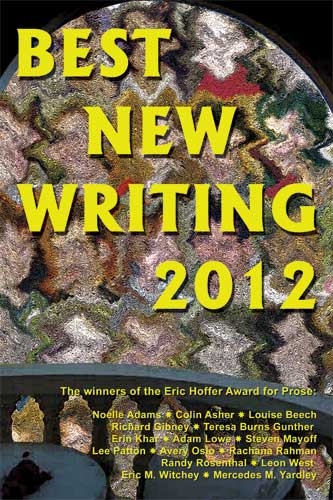
In addition to his current writing career, Christopher J. Helvey is Editor/Publisher of the journal, Trajectory: Writing That Illuminates. He is Fiction Editor on the staff of the Annual Anthology of Best New Writing.  

Christopher J. Helvey
Christopher J. Helvey is a graduate of the Spalding University MFA in Writing program. His fiction and poems have appeared in numerous magazines and journals, including Kentucky Monthly, Idiolect, Kudzu, Nougat, The Chaffin Journal, Ace Weekly, Kentucky Blue, Modern Mountain Magazine, Minnetonka Review, Issue 4, and Best New Writing, 2007. On the Boulevard is his poetry collection and his novel, Purple Adobe, is available from AuthorHouse or fine bookstores everywhere. He lives and writes in Frankfort, Kentucky.

Last week - Part 1 of our Interview focused on your work as a poet, novelist, and short story writer.
Part 2 of our Interview today will focus at your work as an Editor and a Publisher of the literary journal, Trajectory.

Jan:        Thank you again for agreeing to share your insights on publishing.  As Editor and Publisher of the literary journal, Trajectory - why now - in these tough economic times for print journals, did you decide to start a new literary journal?

Chris:       Jan, I began Trajectory because I believed there were voices crying in the wilderness, voices that deserved to be heard, but were not. Based on my experience, many of the current literary reviews and journals are published by universities or colleges. And, quite frequently, their first readers are students. Often, being quite young, they see the world far differently from a writer who is over 40 or 50 or 60. In my opinion, we need more voices, not fewer. We need those who are just starting their journey for their new and fresh ways of looking at life, but we also need those who have already traveled many miles. I wanted to read and print stories, creative nonfiction, and poems from new voices, new voices with experience.  

Jan:        Tell us about your vision for Trajectory. What is your mission? What are your goals?

Chris:        My vision is for Trajectory to be an independent source of some of the finest new fiction, poetry, and creative nonfiction in the world today. My mission is to give print to works that illuminate life for us in new, exciting, unique ways. Our primary goal is really quite simple, to keep publishing as long as there are fine new stories and poems to print and people who want to read them.

Jan:        How did you go about assembling your staff?

Chris:        Our staff is really small. The real workhorse of the team is our graphic designer/layout artist, Myra Summers of Word Management. Myra and I have worked together on dozens of projects over the years and she has always done a great job. Over the issues I've had a few readers, but I end up making most of the final cuts. My wife, Gina, is one of the world's really great proofreaders. She also is a good reader, with an instinct for what works and for what doesn't.

Jan:        What changes do you anticipate for Trajectory in the future? Do you have plans to become an online journal at some point?

Chris:        At some point in the not too distant future I hope to expand the imprint into book publishing. I'll start small, working with one or two writers whose work I admire and whose artistic integrity I admire. I do hope to put more poems and stories online, but only as a supplement to the print journal. I still believe there is a place, granted a smaller one, for printed journals, reviews, and chapbooks.

Jan:        What are you looking for in the poems, creative nonfiction and stories you select for publication?

Chris:        What's the old line about pornography, "I can't define it, but I know it when I see it." Well, that's the way I am about a story or poem. If it speaks to me, resonates at some deep, meaningful level, then it stands a good chance of being accepted. I have no set agenda and am willing to forgive many missteps, but cliches, blatant sentimentality, cardboard characters and wooden dialogue are usually deadly. Often, I know within a few lines if a story or poem is not going to work. As Sena Naslund, author of Ahab's Wife and head of the Spalding University M.F.A in Writing Program (where I earned my degree) says, "You don't have to eat the whole egg to know it is rotten." 

Jan:        What are the basic submission guidelines writers must follow in order to be considered for publication in your journal?  What do you often wish you could ‘whisper softly in the ear’ of aspiring writers who submit work to Trajectory?

Chris:        Except for requiring all submissions to be hard copy (I'm an older guy and my eyes can't take too much reading on the monitor) we are extremely flexible. We are always reading and have no limits on subject matter or length. We are contantly looking for poems, stories, creative nonfiction, and even b&w art or photos. If I could whisper in the ears of all writers I'd say "submit, submit, submit." No journal or review is ever going to take the work stuck in a drawer or in your computer. To those who submit to Trajectory I'd say "if you get rejected, try again--with a better story or poem."

Jan:        Which literary journals do you read regularly?

Chris:        I dip into several as time permits. Recently I've read from Chicago Review, Alligator Juniper, Bayou, Kudzu, New Laurel, and New Southerner. 

Jan:        What is the most difficult part of being Trajectory’s Editor/Publisher?

Chris:        Getting enough really fine submissions, especially stories. It is so frustrating to know that all over the world there are great stories [just sitting] in files, on shelves, in computers. I know it takes time to submit and, of course, there is that old fear of rejection, but come on--take a shot, or two, or three! 

-->
Jan:        Let's talk about your work as Fiction Editor for the annual anthology, Best New Writing.  How did you get involved in this anthology project, and how would you describe your current role?     

Chris:        My first involvement with Best New Writing was as a competitor in the annual Eric Hoffer Fiction Contest. I submitted, I think, in 2007 and was fortunate to be chosen as one of the finalist. Although I didn't win, my story ("Conscientious Objectors") was selected for publication. A year or so later they asked me to come on board as one of their fiction/elimination editors. 


Best New Writing is guided by the Editor-in-Chief, Christopher Klim, who does all the work that nobody else wants to do, like advertising, gathering up the subscriptions to the various editors (five in all), keeping the submissions moving, coordinating the final selections, getting the publication agreements signed and the volumes printed, among other things.

Jan:        What are you as an editor looking for in fiction when you read submissions?

Chris:        When I read a story as an editor, the first thing I look for is a unique voice, one that I haven't read before, one that stands out. However, this voice must be under control. That is, the writer must be able to control the storyline and keep the readers interest. An awful lot of minor flaws (misplaced commas) can be forgiven if I sense a voice and the proper degree of control. Instant turn-offs are trying to be too cute, cliches, sex or violence that is not an integral part of the story, too long a wind up (a lot of writers have a terrible time getting to the story line, causing the readers to give up before the story really takes off). The first paragraph, or at most the first page, is critical. Editors get so many submissions that they simply don't have the luxury of devoting time to a story that fails to quickly engage. And, of course, closing the story strongly is always critical.

As an elimination editor, every three months I read the stories assigned to me, usually around 20, and eliminate all but the very best, most often 2 or 3. The other elimination editors do the same and at the end of the contest year we all score the stories that have survived. Once a winner has been determined, we select (via Skype) the other stories that will be published. Best New Writing is quite a prestigious publication and the competition is always intense. Many good stories have to be eliminated to make way for the exceptional ones.

Jan:        What trends are you seeing in the work published in this anthology?

Chris:        The most noticeable trend I see with Best New Writing is the ever-increasing number of high quality international submissions. We have had some truly powerful stories from England, Canada, Israel, India, and Africa. I think that being able to showcase some of these fine stories is a tremendous infusion into the American literary scene. I'm delighted to be able to play a small part.


Jan:        What inspires you? What makes your day, as a writer, editor, publisher?

Chris:        To find one truly wonderful story or poem, and to know that I can help share it with the world.

Jan:        What’s the most useful advice you’ve received as a publisher and what advice have you chosen to ignore?

Chris:        I'm not sure about "most useful advice." I expect it has come from reading other journals and seeing what they do and how they do it. The advice I chose to ignore was "Don't start a literary journal." Another piece of advice I've ignored to date is to "sell advertising."  I'm not fundamentally opposed to advertising; I've just chosen to go another route.

Jan:        I've talked with writers who submit work to journals that they've never taken the time to read or examine. Often they submit work so far removed from the work a particular journal publishes, and then they wonder why it's rejected. Writers need to support journals they admire so those journals survive long enough to discover and publish their work.  How can one submit work to Trajectory?  And how can someone subscribe to Trajectory

Chris:        Subscribing is easy. Just send a check or money order for $12 for one issue, $20 for 2 issues, or $35 for 4 issues to: Trajectory, P.O. Box 655, Frankfort, KY 40602. Guidelines are on the web site.  Go to:   www.trajectoryjournal.com


Jan Bowman’s work has appeared in Roanoke Review, Big Muddy, Broadkill Review, Trajectory, Third Wednesday, Minimus, Buffalo Spree (97), Folio, The Potomac Review, Musings, Potato Eyes, and others. She won the 2012 Roanoke Review Prize for Fiction. Her stories have been nominated for a Pushcart Prize, Best American Short Stories and a story was a finalist in the “So To Speak” Fiction Contest. She is working on two collections of short stories and currently shopping for a publisher for a completed story collection. She has nonfiction work pending publication in Spring 2013 Issues of Trajectory and Pen-in-Hand. She writes a weekly blog of “Reflections” on the writing life and posts regular interviews with writers and publishers.   Learn more at:


Friday, September 7, 2012

Entry # 91 - "Pace in Fiction!"

I've been revising a story all week and realized that what I thought would take 8-10 hours has taken much more than that. Everything always takes longer than I thought or hoped. Revision sometimes moves at a glacier speed.
Photo credits - Alex Dunn & Jim Wilson - August 2012
As a "grown up" I've come to accept that and even to plan accordingly. And while the story is better, still too much happens - too fast - near the end.  Sometimes that's a good idea, but in this particular story, I am afraid I've built a story traveling at the speed of light at the end.  

The unintended result is an unearned ending, although some readers will see what happens as "reasonable," they will not appreciate being rushed - in the tradition of television sitcoms that resolve a family crisis in time for one last commercial.

So what shall I do about this? I need to reexamine the pace. And what is "pace" anyway, but another word for the speed of the action unfolding in plot? 
Revision - Moves Like the Hubbard Glacier 

  
What techniques affect the pace - the action - of events as they occur in fiction? And what is the effect of using different techniques to manage that action?  And what's the impact on the plot? These are large questions.  
Long languid sentences and rich descriptions slow down the action. In fiction, scenic routes for readers are paved with cobble-stoned streets of adjectives, an occasional adverb and sense images.  
I tend to think of it this way. Complex, layered sentences take readers to "dinner and the movies" for a bit of romance.

Short, tightly constructed sentences with action verbs move action forward. Rapidly. Like the Indianapolis 500. Round those far turns. Jolt the opposition with a surprise maneuver! Zoom. Cross with the checkered flag waving amid a cheering crowd. Not much romance in this. Speed. Flash. Dash. Race over! And the winner is?

Okay,  having said that, the story problem to be resolved has a man, let's just call him Hal for the purpose of this discussion, operating in a panic mode. He's breathless. He is terrified about what might have happened. And then he comes upon the scene that requires him to slam on brakes, slow down, take it all in and come to realize something -- that it's okay, after all. And while he sees this, the scene needs to slow enough at this point for the reader to see a key image and to appreciate more about what's happened than our character Hal sees. 

I think it's going to come down to that key image. And that's the problem here with pacing that has me "playing the scene" repeatedly in my imagination.  I'm trying to get it right.  So I took a break to go to the library and now I'm stalling a bit - so I told myself I had to write this before I dive back into this pesky ending. And now - after I schedule this posting - I will go back to work on it. I will do it!  


When things move too fast toward an ending, the reader can feel cheated. When they move too slowly, the reader wanders off to find something more interesting. Endings that resonate long after the story is over are those that have a key image linked to a larger connection and opens out into something larger. I know this. Now I must turn this knowing into an ending.


Remember:  Tune in on Tuesday, September 11, 2012, for Part Two - Interview with Christopher J. Helvey, which focuses on his work as an editor and publisher for Trajectory and an editor for the annual anthology of Best New Writing.

Jan Bowman’s work has appeared in Roanoke Review, Big Muddy, Broadkill Review, Trajectory, Third Wednesday, Minimus, Buffalo Spree (97), Folio, The Potomac Review, Musings, Potato Eyes, and others. She won the 2012 Roanoke Review Prize for Fiction. Her stories have been nominated for a Pushcart Prize, Best American Short Stories and a story was a finalist in the “So To Speak” Fiction Contest. She is working on two collections of short stories and currently shopping for a publisher for a completed story collection. She has nonfiction work pending publication in Spring 2013 Issues of Trajectory and Pen-in-Hand. She writes a weekly blog of “Reflections” on the writing life and posts regular interviews with writers and publishers.   Learn more at:


Tuesday, September 4, 2012

Entry # 90 - WRITERS TALK - Christopher J. Helvey - Part 1 Poet, Novelist, Editor/Publisher

Christopher J. Helvey
 
Christopher J. Helvey is a graduate of the Spalding University MFA in Writing program. His fiction and poems have appeared in numerous magazines and journals, including Kentucky Monthly, Idiolect, Kudzu, Nougat, The Chaffin Journal, Ace Weekly, Kentucky Blue, Modern Mountain Magazine, Minnetonka Review, Issue 4, and Best New Writing, 2007. On the Boulevard is his poetry collection and his novel, Purple Adobe, is available from AuthorHouse or fine bookstores everywhere. He lives and writes in Frankfort, Kentucky.

In addition to his current writing career, Christopher J. Helvey is Editor/Publisher of the journal, Trajectory: Writing That Illuminates. He is Fiction Editor on the staff of the Annual Anthology of Best New Writing.   Part 2 of our interview will look at his work as an Editor/Publisher.

-->
Part 1 of our Interview will focus on your work as a poet, novelist, and short story writer.

Jan:     Thank you Chris for taking time for this interview.  I didn’t realize it until I began to prepare for this interview that I had seen your poems in Minnetonka Review, a literary journal I used to enjoy reading and subscribed to until recently. In fact that journal was on my list of journals that I had hoped would someday publish my work. Sadly, it has ceased publication. I sent them work for their contests on several occasions.

Minnetonka Review published some of your early poems, including “On the Boulevard,” the title poem for your poetry collection by the same name.  Tell us about that collection.  What is the story behind the story for the birth of your favorite poems in this collection? I've downloaded "On the Boulevard" below.

Chris:     First, Jan, let me echo your sadness on the passing of the Minnetonka Review. What a wonderful little journal that was. Troy Ehlers, the Editor in Chief, is a friend of mine from Spalding Days, and a fine writer himself. "On the Boulevard" was one of those poems that came full-blown into my mind. It pays homage to Hemingway and Bukowski and the noir works of the 1950's. I thought it was a good poem and that it made a catchy title. In addition to the title poem, I suppose two of my favorites are "My Mother Bares Her Breasts in Church." which is based on a true story of my mother baring her breasts to show her Sunday School class her scars following cancer surgery, and "Missouri Nocturne," which evokes my childhood memories of hearing my father singing on our front porch during summer evenings in Crane, Missouri.

-->
On the Boulevard
      
It is three a.m.
and I am reading
Bukowski
writing about
Spain and bulls and Hemingway
and
outside on the boulevard
it is raining
like
pouring piss out of a boot
and
I pour myself another
cup of coffee
and
remember you,
and the shards of
your memory
slice me like
rusty razor blades
and
I bleed,
and
outside on the boulevard
it is raining
like
pouring piss out of a boot.

Jan:       I especially liked the poems about your mother and your father, too. Powerful and starkly realistic work. Now, let's talk about your novel, Purple Adobe (2001, 2002). I recently read and enjoyed it. The plot follows a hard-boiled private investigator, Ward Evans who goes looking for a missing, drug-troubled young woman, Melissa Gibson at the request of her mother, Gloria. He meets up with an equally crabby detective, Hank Nichols. And justice prevails. Tell us a bit about this novel and the traditional detective story models that influenced you.

Chris:     My novel owes a great deal to a man named Kenneth Millar. Mr. Millar wrote under the name Ross Macdonald and his Lew Archer detective series is one of the finest by an American. Lew Archer was always driven by a sense of justice, tempered by mercy, and I suppose my protagonist, Ward Evans, shares those qualities.  


Jan:     These characters are memorable, but ‘place,’ by that I refer to the western setting, seems to take on the role of a character too.  What drove this novel and which came first as you were writing: characters, plot, or setting?

Chris:      Purple Adobe began with the opening sentence which came to me from another dimension very early one morning: "The day died a purple death against the cracked adobe wall." Jan, you are a perceptive reader. Place, indeed, is very much a character in this novel. I have long loved the American west, especially the lonely, and starkly beautiful deserts. I suppose what drove this novel was a sense of encroaching darkness in all our lives, and the light (of love? justice? humanity?) which saves so many of us in the end. 

Jan:     Writers learn new things as they evolve as a writers, what did you learn from writing Purple Adobe?  What would you change if you sat down to write this novel now, ten years later? 

Chris:    I suspect that one learns more by our failures than our successes. While Purple Adobe has a number of good qualities (strong sense of place, a story that moves along nicely, a theme that justice prevails),  it is far from a perfect work. It suffers at times from the dreaded "purple prose" syndrome, and in the days when I was working on that novel I was afflicted with "simileitis" (too many similes). Brad Watson, author of The Heaven of Mercury, first recognized that I had this illness when I was a student in one of his workshops at Spalding. Today, I would utilize a much more sparse language, utilize less description, and cut down on the sex scene.  Less, indeed, is often more.


Jan:     You are a graduate of the MFA program at Spalding University.  Tell us what you gained and what you may well have lost as a result of your graduate program experiences.

Chris:      I don't know that I have lost anything as a result of my time at the Spalding MFA program. I met so many wonderful people and learned so many lessons. Two of those lessons that stand out were how to take criticism and how critical rewriting is. I gained a sense of belonging to a greater community of writers, a better understanding of what makes a story work, and many wonderful friends.


Jan:      I agree. Having a community of writers provides support. And most new writers don't fully appreciate the importance of rewriting in the writing process to bring out the best of a work. If you were to describe your idea of the (almost) ‘perfect’ short story, what elements would it have? And which stories come closest to your vision of a perfect story?

Chris:     Jan, that is a really tough question to answer. Of course, there is no 'perfect' short story, but for me it would be written with an almost brutal economy of language, yet at the same time contain a new vision, a new way of looking at the world, and I am a huge fan of what I call "hammer-time" endings, endings that leave you changed, endings that leave you a different person from who you were before you read them. As for an almost perfect short story, I'd have to select "Cathedral" by Raymond Carver, or maybe,"The Killers,"or "Hills Like White Elephants," and "The Short Happy Life of Francis Macomber" all by Ernest Hemingway.


Jan:     Your literary journal, Trajectory keeps you busy meeting deadlines, but in your own writing life, what are you writing now?

Chris: I'm polishing up a collection of some of my best unpublished short stories (my working title is Clawhammer) and I will start sending it around soon. I've also just finished first drafts of a novel and a novella. It is way too early to know if they will be keepers, or merely good workouts. 


Jan:     Who are your literary influences?

Chris:     Hemingway, without question, would have to be foremost--for the freshness of his language if nothing else. Ross Macdonald, as noted above, is another. I would also have to give credit, or blame as the case may be, to Raymond Carver, Richard Ford, for his early stories, Bukowski,  Larry Brown, and, for his glorious, moving descriptions of place, James Lee Burke. One of my core beliefs is that every writer we read influences us to some degree, in one direction or another. Some influence to write in a certain manner, or on certain subjects. Others send us scurrying in another direction, vowing never to write like that.


Jan:     What book has had the greatest impact on your writing life?

Chris:   Without a doubt, I'd have to say The Sun Also Rises. In that novel Hemingway made me aware for the first time that there was another, often better, way to say things, that language was pliable and could be molded. Also, in that work he also taught me a good deal of what I know about writing dialogue. 


Jan:     What are you reading now?  What are the top four books on your ‘to read’ stack?

Chris:      I'm one of these people who keep dipping into several books at once. At the moment, I am reading The Same Terrible Storm  (stories) by Sheldon Lee Compton, a promising young writer and friend from Kentucky (by the way the stories are brief, dark, brutal, and beautiful), Men in the Making (stories) by Bruce Machart, Rope Burns (stories) by F.X. Toole, The Sojourn (novel) by Andrew Krivak, Welding with Children (stories) by Tim Gautreaux, what matters most is how well you walk through the fire (newly relased poems) by Bukowski, Fitzgerald and Hemingway, Works and Days (collected essays) by Scott Donaldson, and a number of Slave Narratives (interviews with former slaves collected by state) from the Federal Writers' Project of the WPA (1936-1938).


Jan:     Is there a "must read" book on writing that you would recommend to any aspiring writer?

Chris: There are several good, useful books on "how to write." Three that I've found beneficial are Writing the Novel by Lawrence Block, Writing Down the Bones by Natalie Goldberg, and Writing Fiction, A Guide to Narrative Craft by Janet Burroway and Elizabeth Stuckey-French. Oh, and I want to mention as helpful, Burning Down The House, Essays on Fiction by Charles Baxter. Richard Goodman has a book on writing out that is both edifying and challenging. The title is The Soul of Creative Writing. One that is replete with literary gems is Ernest Hemingway on Writing (a collection of his comments in letters, interviews, commissioned articles, edited by Larry W. Phillips).

Jan:     What is the most useful writing advice you’ve ever received and what advice  have you wisely chosen to ignore?

Chris: The two best pieces of writing advice I've ever received are "Quit talking about writing and sit down and start writing" (paraphrased from a number of excellent teachers and writing gurus) and "Baby, you don't want to take five pages to get your hero from one end of a barn to the other." That one is from my wife and it stuck a dagger through one of my greatest weakness as a writer, which is never use one good adjective or simile when you might be able to squeeze in two, or three, or four...

As for the piece of advice I've chosen to ignore: "Write only what you know." What bad advice! If we listened to those words most of the novels and stories we write would surely be rather boring. If everyone followed that advice there would be no science fiction written and darn fewer murder mysteries. The person who first gave that advice must have blanked on the use of imagination. Perhaps it is okay to start a novel or story writing about what you know, but my advice is to start letting the imagination flow, and sooner rather than later. 

Tune in Next Tuesday for - Part 2 of Christopher J. Helvey's Interview.  For Submission Guidelines & Subscription Information for Trajectory - Go to: www.trajectoryjournal.com


Jan Bowman’s work has appeared in Roanoke Review, Big Muddy, Broadkill Review, Trajectory, Third Wednesday, Minimus, Buffalo Spree (97), Folio, The Potomac Review, Musings, Potato Eyes, and others. She won the 2012 Roanoke Review Prize for Fiction. Her stories have been nominated for a Pushcart Prize, Best American Short Stories and a story was a finalist in the “So To Speak” Fiction Contest. She is working on two collections of short stories and currently shopping for a publisher for a completed story collection. She has nonfiction work pending publication in Spring 2013 Issues of Trajectory and Pen-in-Hand. She writes a weekly blog of “Reflections” on the writing life and posts regular interviews with writers and publishers.   Learn more at: